Monday, August 16, 2010

Pharisees


Eleventh Sunday in Ordinary Time

Homily

“Pharisees”


Opening

Sin is all around us. It’s insidious. You find it oozing into the strangest places, like some out-of-control oil spill, fowling everything it touches and smothering the life out of it.


Whether it’s the strangling in that hotel room in Peru or the shooting of that poor girl on Esther Street, or the unnumbered moments in our own houses of impatience, judgment, and selfishness, none of us can escape the fact that we are each a sinner before God and man.


Even David, the anointed of the Lord, the King of Israel can’t escape it. Oh, he thinks he can. In fact, having arranged the death of Uriah the Hittite to cover up his affair with Bathsheba, David’s pretty sure he’s gotten away with it.


Until the Prophet Nathan uncovers his crime and converts the King into a weeping penitent, whose sin will be told down through the ages. Even in the genealogy of Saint Matthew’s Gospel David is identified as “the father of Solomon, whose mother had been Uriah's wife.” The genealogy of the Son of God is replete with such characters. For there’s a strange appropriateness that the incarnation of him who became man to free us from sin should be descended from such a tainted ancestry.


Modern Day Pharisees

And so too with you and me. I fear I am too often one of those modern day Pharisees who are as convinced of their immaculate conception as they are of their ability to save themselves. But despite Pelagius, no one has ever really been able to save anyone, except for our Lord and Savior Jesus Christ. Only Jesus saves. And only he and his Blessed Mother have lived lives entirely free from sin.


I can save no one, including myself, without the grace of our Lord Jesus Christ. At the end of the day, when I make my nightly examination of conscience kneeling down by my bed, I can only rely on the unwarranted mercy of a gracious God, who looks upon me in my sinfulness and gives me the grace to live another day in his service.


The confession of my sins and the destructive patterns of sin which are woven into the very fabric of my life, is the second greatest truth I can profess; while the greatest truth is God’s undefeated mercy. Thus, with the Psalmist I can sing: “I confess my faults to the LORD, and you took away the guilt of my sin.”


Our Frailty, God’s Grace

It’s like the Collect, in the forthcoming translation, for this Sunday, which asks God to “graciously hear our pleas,” for “without you, mortal frailty can do nothing...”


Mortal frailty can do nothing.


Did you do good works this week?

Thank God, for he gave you the grace and the strength to accomplish them.


Did you manage to forgive that person who hurt you?

Thank God, for he taught you to look down from the cross they built for you with mercy and even love.


Yet, I sometimes strain the muscles in my right arm by my repeated attempts to pat myself on the back for just how wonderful I have been. I fed the hungry, I clothed the naked, I listened patiently to those who were a pain, I forgave someone who slighted me, I prayed for an extra five minutes. Open the cause for my canonization. God is just so lucky to have me as his servant.


Such self-congratulatory pablum was unknown to Blessed Theresa when she first experienced her calling to serve the poorest of the poor, and wrote this to the Archbishop of Calcutta:

“The thoughts of my unworthiness for all God’s gifts to me and to my children gets deeper and clearer. In my meditations and prayers, which are full of distractions nowadays, there stands one thing very clear: my weakness and his greatness. I fear all things from my weakness...I I trust blindly in his greatness.”


At Simon’s House

That’s what’s going on at the house of Simon the Pharisee when Jesus arrives in today’s Gospel. They eat, they talk, they have a good time. Simon’s the good guy, the friend of the Lord.


Then, in comes this woman, a sinner, who crawls up behind Jesus and clings to his feet, literally washing them with a flood of tears, begging for his mercy.


Meanwhile, Simon the Pharisee is furious. How can Jesus let this happen? Doesn’t he know who she is? This filthy woman disrupting his important supper and groping the Lord’s feet just as Simon is making his reputation as a friend of Jesus?


But Jesus does know who she is. And that’s why he lets her cling to him and weep. But Jesus also knows who Simon is. He knows his ambition, he knows his high self-regard, and his knows his sin of presumption. Simon’s just as sinful as that woman. The only difference between the two is that she accepted the grace to confess what a mess she was with her tears.


So Jesus says to Simon, you did not welcome me to your home with an embrace, but she cannot stop kissing me. You did not offer to wash my feet with water, but she has cleansed them with her tears.


Jesus has turned Simon’s house on its head and reminded Simon and me and you that our solitary boast is in the cross of our Lord Jesus Christ. Without the grave which flowed with blood and water from his side, we can do nothing.


Conclusion

Psalm 22 is a Psalm that may, ionically, have been penned by King David himself. And in the sixth verse we find the truest words ever spoken: I am a worm and no man...I am nothing but a worm without his redeeming love.


Monsgnor James P. Moroney

Rector

Stewardship

Homily

Sixth Sunday in Ordinary Time

Stewardship


God’s greatest gift to us is love. And all he asks for in return is trust.


Trust in his care for us and for all of his creation.

Trust in his Holy Will, and the plan he has laid out for each one of us.

Trust that his promises to us will be fulfilled.


But trust is never easy, for it requires belief in what is unseen, hope in what others cannot readily discern, and belief that what is most real is known only by the heart that chooses to believe.


I think of the old trust game they used to use in Outward Bound: Close your eyes, fold your hands over your chest, and fall back into the secure arms of another. Trust that he will be there. Trust that he is strong enough to keep you from falling to the ground. Trust in his presence and in his care.


From our first breath to our last, life is but a series of exercises in trusting God. Do I so believe in his wisdom that I place my life in his hands more quickly than I will in my own? Do I so believe in his love that I let go of everything that does not lead me to or come from him? Is my faith so sure that I will let myself fall into his arms alone and trust that I will be safer than before I even started to fall?


But I am so tempted, with Jeremiah, to trust more in the flesh than in an invisible God!

To seek to be rich, over-stuffed, laughing, vengeful and victorious! To grab for all the gusto I can get in this life.


But then Jesus comes along and asks me to trust:

to trust enough to be poor, that he might enrich me with his grace

to trust enough to be hungry, that he alone might satisfy me

to trust enough to weep, that he might show me perfect joy

to trust enough to forgive, that he might shower me with mercy

to trust enough to take the last place, that he might lead me to glory with him forever.


On each dollar bill we carry in our pockets and pocket books appears the words In God We Trust. As a country, as a cathedral, and a Catholic may we live those words with all our hearts.


On Suffering


Homily

Second Sunday in Ordinary Time

“Suffering”


They had run out of wine. Now that may not seem very serious, but just stop and think about the last wedding reception you went to, and imagine if they had run out of wine, and scotch and gin and absolute vodka.


And imagine that you were the mother of the bride or the father of the groom...what would you do? You'd probably throw a fit with the bar tender or fire the wedding planner or demand to speak with the cater.


But at the banquet hall in Cana, something else happens: two things happen. First, someone goes to Mary, and asks her to go to Jesus.


And then, they follow her explicit command: do whatever he tells you. They take simple, ordinary tap water (not San Pellegrino or Evian or even Vos), simple, ordinary tap water to him, and he turns it into the finest of wines.


They felt forsaken. But they did two things: they went to Mary and then did what he told them, and Jesus took whatever they had and changed it into something better than they had ever dreamed of.


So when you feel forsaken, do two things. First, pray to Mary and second, do what her Son tell you. Prayer is essential, but so is action.


It is said that when Moses sought to lead the chosen people through the Red Sea, he lifted his staff, but for a moment, nothing happened, until the first brave Israelite stuck a trembling toe into the water, at which the waters parted and the chosen people fled Pharaohs deadly wrath.


Ora et labora, as Saint Benedict used to say. When you feel forsaken, Ora et labora.


The Girl Under the Slab

Did you see the 14 year old girl in Haiti whose school collapsed on top of her? It was the first CNN video that ever made me cry. Here was this huge concrete slab above which five men with one shovel dug desperately. They had been attracted to the slab by a whimper, followed by a strange thudding sound. At least they thought at first that they were whimpers, until, after eight hours they pulled her out. Once they has dusted her off she was in remarkably good shape as they asked her what she had seen and heard and said.


She had seen nothing in the pitch blackness and heard only the weeping of an old woman somewhere down below her, who, with fading cries just kept saying, I'm going to die, I'm going to die.


It was then that the little girl under the concrete slab started to pray. I just kept saying the Hail Mary, she grinned, and I could see the mother Mary and I knew she'd get Jesus to help me. And after she prayed each Ave, she worked up the courage to bang on the roof of her concrete prison. Now and at the hour of my death. BANG. Now and at the hour of my death. BANG Now and at the hour of my death. BANG. And that’s the whimper and the thud which caught the attention of the rescuers above.


She had felt forsaken. And she went to Mary, who went to Jesus, and he changed the little she had into more than she could have imagined!


The People in Haiti

There is much we can do for our brothers and sisters in Haiti. To the world it looks hopeless...a third of the country homeless, tens of thousands of dead bodies decaying in the streets, roads so damaged that not even water can get through. Not even water.


They seem forsaken, but rest assured that He who made heaven and earth can recreate the darkest chaos with a new springtime of hope and of beauty and of light. And we can help.


  • By going to Mary and beging her to ask her son to take what little they have and transform it into more than they could have ever gave hoped for. We can get down on our knees, rosaries in hand, and go to her who brought to birth the one who made the heavens and the earth.


  • And to our prayer we can add our deeds. We can be a part of his recreating lives by our generosity to Catholic Relief Services in the second collection for Haiti today. We can urge our government and all relief agencies to do whatever they can to come to the aid of those who have suffered unimaginably in this island nation.


And while our hearts go out in a special way to those who suffer in Haiti, we should not forget all the others who need our prayers, as well.


  • Like the 69 year old man in Spencer this week, who shot and killed his wife and then set the house on fire and took his own life. His wife had been dying of pituitary cancer and the house was about to be auctioned following foreclosure. He felt forsaken, Blessed Mother, pray to Jesus for him. And teach us how to reach out to and support all who labor under the ravages of disease or financial ruin.


  • Or like the nine people were left homeless on Friday night after a fire destroyed their three-decker on Vernon hill. Those nine folks must feel so forsaken. Blessed Mother, pray for them to Jesus. And give us the will to find and help all who are homeless or alone or afraid.


  • This coming Thursday is the anniversary of Roe versus Wade. On this day, and on every day, we should pray to the Mother of all Christians for the littlest victims among us. But let us do what he tells us, as well, like the busload of Cathedral marchers who will sleep on the bus all night in order to march all day in D.C. Let us recommit ourselves to work for life through our support of Visitation House, and Project Rachel, and by teaching all young men and women about the dignity of life from conception to natural death by the way we treat the weakest and the most vulnerable among us.


For all who suffer or who feel forsaken, let us pray to the Mother of God, and then, let us do whatever her Son tells us to do.


Monsignor James P. Moroney

Rector

Wednesday, July 14, 2010

OF KNIGHTS AND SISTERS AND SUMMERTIME...

Next weekend we say good bye to some old and dear friends. The Franciscan Sisters Minor have been a part of the Cathedral Parish since just a short time before I arrived as your rector. Through your generous support, they have lived a life of contemplation and evangelization on behalf of the Church in downtown Worcester.


During the past year, however, the sisters have been engaged in a time of discernment, as the Franciscan Brothers Minor have moved to the Diocese of South Bend in Indiana. After much prayer, the sisters made the decision to move to South bend, where they will be welcomed by Bishop Kevin Rhoades.


They will be dearly missed, but will never be far from our prayers here at Saint Paul’s Cathedral. Please join me next weekend after the 10:15am Mass in bidding the sisters farewell in the Cenacle with coffee and donuts and aching hearts! You, our dear sisters, will never be far from our hearts!


Also next weekend at the 10:15am mass we will be commemorating the installation of the new officers of our Cathedral Chapter of the Knights of Columbus. I strongly encourage all of the men of our parish to consider becoming a Knight. As a Knight for the past thirty years, I can tell you that the fraternity, good works, and devotion to the mission of the Church exhibited by the Knights of Columbus is second to none!


So, during the coming week (may God grant us a relief from the heat!) let us remember Sisters and Knights, and all God’s manifold gifts!


In the Lord,


Monsignor James P. Moroney

rectorsaintpauls@aol.com


Thursday, July 1, 2010

JOIN US FOR MASS!


Mass at the Cathedral of Saint Paul is televised Daily and Sundays thanks to the TV Ministry of the Diocese of Worcester and can be viewed by clicking below:


Wednesday, June 30, 2010

Thirty Years and Thirty Hours


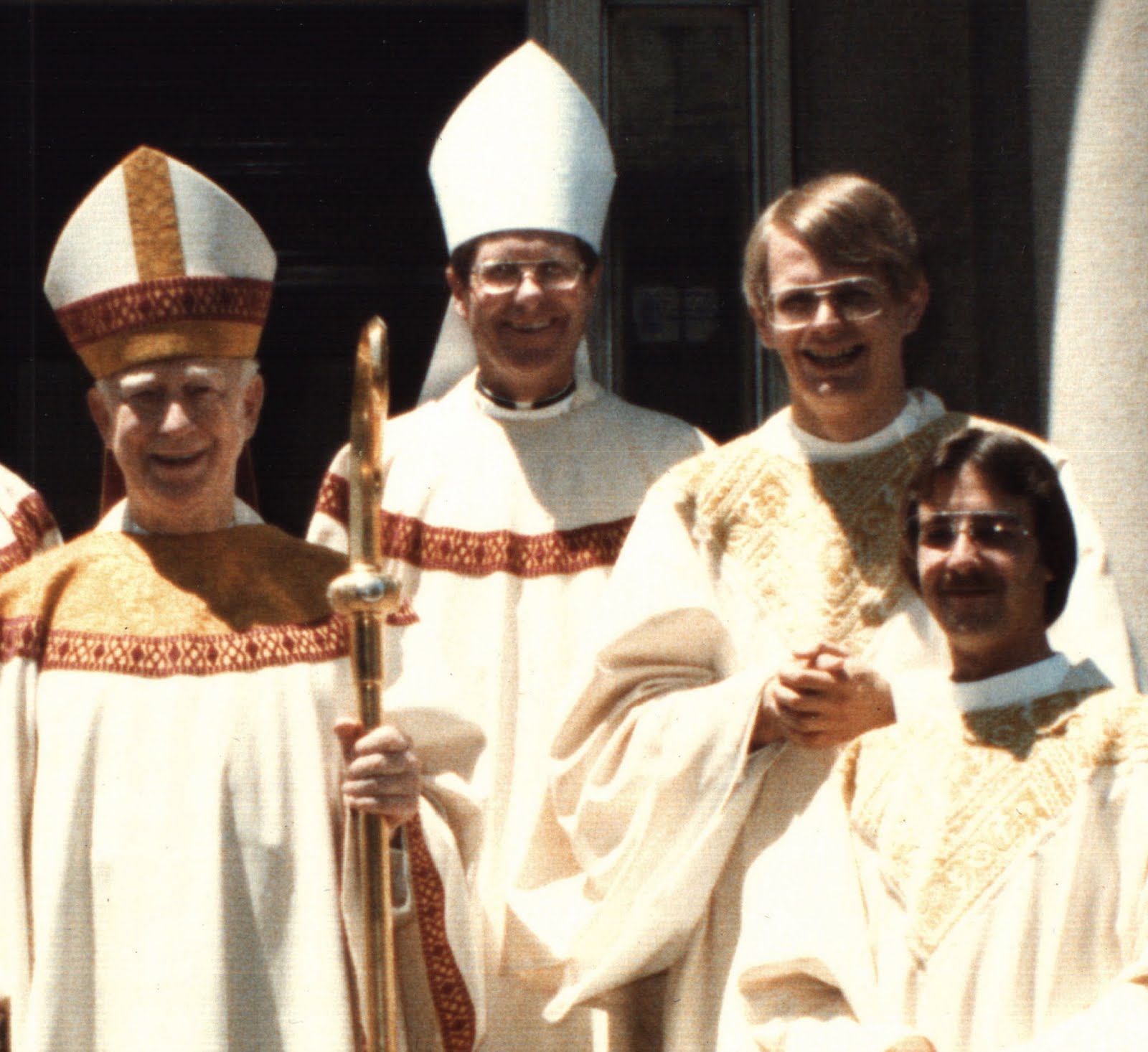
Thirty years ago I knelt before Bishop Flanagan and he laid his hands on my head and made me a Priest of Jesus Christ. Thirty hours ago, Father Nicholas Desimone, who concelebrates this morning’s Mass, knelt before Bishop McManus, who laid his hands on his head and ordained him to that same Priesthood.


I am honored by your presence, Father Desimone, for you are a sacrament for us...you remind us of Christ’s presence and action in his Church in every age, in every place...And you remind me of me, just thirty short years ago. Little did I suspect what God had in store for me. And here I stand, surrounded by as many memories as you have dreams...


....of Christ healing sinners and drying tears, of Christ offering his perfect sacrifice through your hands, of Christ proclaiming his good news through your lips, of Christ Baptizing into his death and resurrection, of Christ burying the dead...


And all through our hands. Simple, human hands, still moist (in your case) with Holy Chrism. It is a wonder, a miracle, and a perfect joy.


Accipe

Yesterday, following his ordination by the laying on of hands and the Prayer of Ordination, Father Desimone was vested, anointed, and finally knelt before the bishop, who, for the first time, handed him a chalice filled with wine mixed with water and a paten with the bread for the Eucharist. As he received these gifts, the Bishop said to him:


Accept from the holy people of God the gifts to be offered to him.

Know what you are doing, and imitate the mystery you celebrate:

model your life on the mystery of the Lord's cross.


Notice that as these ancient words were spoken, it is the gifts of the holy people of God, your gifts, that were placed into Father’s hands. For in a just a few minutes, a few of you will bring forward gifts of bread and wine for the celebration of the Eucharist. Mixed in with those pieces of bread are the sacrifices of your lives. And with the wine in that cruet are mixed the joys and sorrows, the longings and holy desires of each member of this gathered assembly. At this presentation you are like the Magi bringing gifts to the Christ child. But your gifts are of an even greater value than gold, frankincense and myrrh, for these are the gift of our very lives. For “your prayers, and your faith, and your blood, [are mixed]with His in the chalice. These, like the water and wine, form the matter of his sacrifice.”


The Priest receives those gifts in the person of Christ. He places them upon the altar in the same way that Christ placed his body upon the altar of the cross in a perfect sacrifice of praise. And these gifts are transformed by the great Eucharistic prayer into the very Body and Blood of Christ, and then returned to us as our nourishment that we might have the strength to continue to join ourselves with Christ’s sacrifice every day of our lives.


That is why the Bishop first tells the Priest to know what you are doing: to know that you take into your hands the sacrifices, the souls, and the very lives of the people of God to be joined to his perfect sacrifice of Praise and to be transformed into his own Body and Blood. He carries them in their victories and in their defeats, in their joys and in their sorrows, in their strength an in their brokenness. He kneels down and begs God’s mercy on them with his whole heart and soul.


Two years ago, Bishop McManus called me to serve this good Cathedral Church and the seminarians of Saint John’s; A dozen or so years before that, Bishop Reilly sent me to Washington to serve the Bishops’ Conference; Five years before that Bishop Harrington made me pastor of the newly formed parish in Spencer, before which, on the tenth anniversary of my ordination, he had sent me back to school.


Before that I had been sent by Bishop Flanagan to Saint Leo’s in Leominster, and before that to my first parish, Sacred Heart in Webster, and even before that, to my first temporary assignment in West Boylston, where the beloved Father John Burke, once of this great Church, was recuperating.


Father Desimone has just been sent by Bishop McManus to one of the new parishes in Fitchburg and then he will return to studies in ecclesiology at the Greg. Only God knows the wonders which will await him in the years to come. But one thing is certain. God has called us both to a great adventure, filled with more joy and peace than a human heart can contain. And each day for the past three decades, God has looked on this lowly servant and shown a mercy of which I am totally undeserving. And all I pray is that for the next thirty or sixty years, Nick, God does the same for you.


When I think of this Priesthood which we share, I think of a simple scene I witnessed during my sabbatical several years ago. As I sat at my desk in Assisi looking out across the piazza in front of the Cathedral, there were a dozen kids playing soccer. The twelfth century stone lions served as goal posts and the door of the Church was the goal.


The Pastor walked by the kids on his way to Mass and stopped. He puzzled over whether he should yell at them about possibly doing damage with their games. And then he smiled and went into Church.


They looked on with amazement at Father, this little incarnation of mercy. They wondered about him and about who he was. And as they played their games, they trusted that he was inside praying for them; that that when they would get lost in the coming years, that he would help them get home; and that when the pain would get like the cross he would help them to understand.


They need him to be their Priest, and to lead them to Jesus. And, with the grace of God, he will try.


Monsignor James P. Moroney

Rector


Father DeSimone’s First Mass Homily


As an older brother whom you have called Father, I have been particularly touched by the wondrous ways in which Christ has conformed you to his own image. The words spoken by the Bishop as he placed the chalice and paten into your hands a mere 30 hours ago have been lived by you since that your mother first carried you in her arms. Through all the years, on all the many roads, you have sought to know what you were doing, to imitate the mysteries you have celebrated and to conform yourself to the mystery of the Lord’s Cross.


I am also touched by the appropriateness of the wonderful Gospel which the Church has chosen for this day on which, for the first time, the sacrifice is offered at your hands for our good and the good of all his holy Church.


Anointed yesterday

For after thirty years of Priesthood, I can understand Elijah, to whom God gave the grace to know Elisha, the one who would succeed him.


Notice it was not Elijah who chose Elisha, it was God. Like Bishop McManus calling Father Desimone to the Priesthood yesterday morning, Elijah chose this young disciple because God had told him to.


And just as Elijah threw his cloak on the new prophet’s shoulders, so did Father Rose place a chasuble over his head. And as Elijah anointed the prophet Elisha, so did Bishop McManus smear Father Desimone’s hands with the holy Chrism.


For just as Elisha responded to the call of the Lord and followed Elijah, so does Nick


Follow me

You are not unlike the mysterious figure in today’s Gospel, whom Saint Luke only refers to only as someone. This unknown figure goes up to Jesus on the road and says with all your enthusiasm: “I will follow you wherever you go” (Lk 9:57).


The figure is a sort of type, a foreshadowing of the Priest who yesterday knelt before his Bishop and folded his hands between the Bishop’s palms, as if between the hands of Christ, and promised obedience for the rest of his life.


It’s an act which the world finds laughable and totally beyond belief. To give up your own will, for the will of another? Can’t you think for yourself?You’re bright. Don’t you want to be success? Didn’t you hear Jesus when he says follow me to a life with no place to rest your head? Didn’t you hear Jesus when he promised that they would revile and persecute his followers as they reviled and persecuted him? Follow me? Follow him to what? To poverty? To pain? To sacrifice? To the cross?


No wonder there’s a vocation shortage. Sounds like we’re lacking a very good marketing strategy.


And if we were selling a commercial product, that would be ever so true. But what Father Desimone has given up his life for is not a product, but a person. A man who hangs upon a cross.


And when, as a little kid, that man first started whispering in your heart: follow me...And when on Mount Saint James, at the strangest times, you would hear him whisper: follow me...and when even on the Janiculum Hill he would smile down at you and whisper, follow me....he was calling you to a life of perfect joy...a sacrifice of praise...which leads to the heart of the meaning of life.


To the cross. To the place where there is no control nor desire for control, no decisions to be made, no problems to figure out or programs to plan, but only you and Christ and the cross and the people to whom he sends you.


The disciple tells the Lord to whom he has promised obedience that he wants to go bury his father, and say good bye to him family, and the Lord says no. “Let the dead bury their dead. You...you do what I tell you, and go out and proclaim the Kingdom of God.


Only God’s will matters, no matter what your head or your heart or your gut tell you. It is God’s will and the will of his Church to which you totally give your life.


The last thing Maximilian Kolbe wanted to do was to starve to death at the bottom of a pit. But it was God’s will. The last thing Damian of Molakai wanted to do was to go work with lepers on an island half way across the world. But it was God’s will.


Of all the promises a Priest takes, perhaps the most counter-cultural is the promise of obedience. But perhaps it is also the most important. For it says there is something greater than me here...a mystery of God’s love in which dying is more important than living, letting go more important than clinging on, surrender more important than control, and obedience more important than being right. As the Lord Jesus hung upon the cross, in perfect obedience to the Father, he let go of everything, to his last breath in perfect fulfillment of God’s will. Conformed to that perfect obedience, the Priest is called to do the same.


So when the world looks at that man in black with the funny white collar who has given up striving for success, career, and family and even his own will in the name of God they will see not Nick Desimone or Jim Moroney, or Charlie Armey, or Mike Rose. They will see Christ.


For in the end, that’s what it’s all about.


We’re here today because we love you, Father. We love you as a son, as a brother, as a friend, and now, as a Priest.


You will take up the cup of salvation and call upon the Lord for us, you will offer his perfect sacrifice for us, joining us to him and making sense of our lives. You will baptize us into his death and resurrection, feed us with his Body and Blood, seal our covenants, heal our sick, forgive our sins and bury our dead. You will be Christ for us.


Not because we chose you, but because he chose you, and sent you to be our shepherd and our Priest.


Saint Francis of Assisi used to say that if he met a saint and a priest on the road he would be nice to the saint, but he would kiss the hands of the Priest. We venerate those hands which you have placed into the hands of Christ and which will touch us with the mysteries of his love for many many years to come.


Monsignor James P. Moroney