Thursday, November 25, 2010

Thanksgiving


Thanksgiving
Homily

We come here, on this Thanksgiving Day, to offer the Holy Eucharist... comes from the Latin Eucharistia, which comes from the Greek Eucharistein, which comes from the Hebrew Berakah.

Berakah is a funny word in Hebrew. It means thanksgiving, but it always requires two actions: to remember the great works God has done for us and, second, that we bless him for his goodness to us. Its like the ancient Berkahs which served as a model for the prayers the Bishop will pray in just a few moments at the preparation of the Gfts: Barukh Attah Adonai Eloheinu Melekh ha-Olam = Blessed are you, Lord our God, King of the Universe.

So to give thanks we must do two things: remember and bless.

We should, therefore, do everything we can to remember the mercies of God.

Now, it's not that we're really that bad at remembering. In fact we're really quite good at remembering everything that went bad this past year. The promotion you didn't get, the diagnosis you didn't want, the ice storm that caused that accident with the car, and all the manifold ways in which we are sometimes convinced that God sits up like some sadistic patriarch trying to make us miserable. No, we're quite good at remembering.

But we're not so good at remembering his mercies, and his bountiful gifts to us.

I was reminded of this last week, when I saw an old friend who had come to celebrate Confirmation with Bishop McManus last Sunday afternoon. When he entered the sacristy he was carrying a funny looking machine on his back, which processed oxygen and fed it to his weakened lungs through two plastic tubes in his nose. I expressed surprise and concern and he told me matter of factly, Oh, it’s not so bad. I need the machine for half the time now, soon it will be full time.

Counting My Blessings

For the rest of the afternoon, I I never stopped counting my breaths...these airy blessing which God gives me five times a minute. He made the air you breathe and formed the lungs you breathe with. He is the reason your heart beats and how the blood flows through your veins....your feelings and your fears, your joys and each of your hopes. He made it all. And when’s the last time I said "thank you" for that?

When’s the last time I remembered the deepest pleasure of a good nights sleep, or the wonder of the first deep breath of cold fresh air, the overwhelming colors of a maple tree in fall, or the awesome quiet of the new fallen snow, the indescribable beauty of a springtime blossom, or the soothing warmth of a summer’s breeze?

In stubborn foolishness, I refuse to remember his mercies, so how can I ever hope to give thanks?

And to really give thanks I need not only to remember, but to bless God for his infinite mercies! In other words, the only posture from which thanksgiving makes sense is on my knees in front of a cross. Only then do I know that I am little and God is big. Only then do I know that at the end of the day and at the beginning and at every moment in between he is in charge not me.

This is what brings us to this Thanksgiving day, and to this altar, where the great sacrifice of praise, the eucharistia is offered with us and on our behalf.

This is what brings us to join the sacrifices of our lives to the perfect sacrifice Christ, who rose triumphant from the tomb in the perfect Berakah: the perfect sacrifice of remembering and blessing.

A little more than a hundred years ago, not so very far from here, Emily Dickinson wrote a poem about a man who had died a year before: a man who, from the grave, saw for the first time all the blessings of the fields that surrounded him throughout his life. He speaks from the grave:

... I know I heard the Corn,
When I was carried by the Farms--
It had the Tassels on--

I thought how yellow it would look--
When Richard went to mill--
And then, I wanted to get out,
But something held my will.

I thought just how Red--Apples wedged
The Stubble's joints between--
And the Carts stooping round the fields
To take the Pumpkins in--

I wondered which would miss me, least,
And when Thanksgiving, came,
If Father'd multiply the plates--
To make an even Sum--

Need we wait until we’re dead to remember his mercies and to bless his name?

Need we wait? Or can we not bless him for all the myriad ways he has loved us and loves us still?


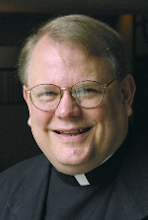
Monsignor James P. Moroney
Rector

Sunday, November 21, 2010

Christ the King


A Homily for the Solemnity of Christ the King

Who is this Christ, who even opponents of monarchy call their King?  Who is this Lord, to whom we have given our lives and our devotion?  Who is this Jesus at whose name we bend the knee and for whom we long with our every waking breath?

Saint Paul tells us who he is in his letter to the Collosians.    

First: He is the image of the invisible God.
No one, as Jesus tells us, has ever seen the Father.  But whoever looks upon the Son and believes in him sees God.  

He is the image of the invisible God.
Do you remember when Philip says to Jesus, Lord, show us the Father?  And do remember Jesus' response.  Philip, you have been with me so long and still you do not know me?

He is the image of the invisible God.
He is the word made flesh, the splendor of the Father, Emmanuel, God with us.

He is salvation for the old woman who lives alone with nothing but her fears, and for everyone abandoned by love, life completely out of control.  He is the image of the invisible God.

Second: He is the firstborn of all creation.
Before anything is, he was.  Through him all things were made.  Apart from him, nothing came to be.  Which is why his dominion is an everlasting dominion and all creation is subject to him.  Do you want to know why God made you?  Look to Jesus, for his is the ground of all being and the source of all meaning.  Apart from him there is no life or meaning or truth.  He is the firstborn of all creation.

He is salvation for the addict who slept on the street last night, and for everyone who is empty, lost, or unsure what you should do.  He is the firstborn of all creation.

And third: Through this one who was before all things, all things are held together.

Apart from him there is chaos and dystrophy and death.  He is the way, the truth, and the life and nothing holds together except through him.  He is the glue that keeps it all from flying apart, the peace which brings joy to men's souls, and the grace which reconciles enemies.

He is salvation for those who are beaten or angry, or frightened or broken.  Only he can make them whole.

He is, he was, and he heals.  Like he did from the Altar of the Cross.  As he opened his arms in a perfect sacrifice of praise, as the blood drained from his body and his consciousness began to fade, he hears the criminals on either side if him begin to scream.

Both were guilty.  Both were on their way to hell for murder of fomenting insurrection or worse.  And miserable wretches that they were, they appeared to be spending their dying breaths telling others what to do.

The one on his left joins the sneering crowd and reviles Jesus: I thought you were supposed to be the Christ!  How ‘out saving yourself, and us too while you're at it!

Notice Jesus never answers to the bad thief.  Perhaps he knows this guy who dies cursing God is finally beyond hope.  But the other thief does respond, shouting across Jesus: don't you fear God?  How can you say such a thing?  We're guilty.  We deserve what we got! But he's not!  

And then he turns to Jesus, and with hi last breath begs him,  Jesus, remember me when you come into your kingdom.

And in the next to the last word he would ever speak, Jesus forgives the sins of this lifeline criminal, and assures him:  today you will be with me in Paradise.

Jesus forgives the criminal because he knows him.  It was through Jesus that he was created and it was to live in the image and likeness of Jesus, the splendor of the image of the invisible God, that he was made.

Jesus forgives the criminal because he loves him, because he desires not the death of the sinner, but that he repent and live, because all it takes to heal a lifetime of sin is a moment of love, for to him who has loved deeply much is forgiven.

And here we are, repentant thieves, the lot of us.  Standing before the altar from which our King, who ever was and ever will be, who made us for love and sacrifice and joy, waits for us to have half the faith of the crooks on the cross.

He is a King, he longs to love us, and to lead us home.  


Monsignor James P. Moroney
Rector

Thursday, November 11, 2010

Monsignor Sullivan Reflects on Cardinal Newman


This address was presented to the Catechists of the Diocese of Worcester by our own Monsignor Sullivan this past week.

First, thanks for what you're doing as educators. It's really important.

I say that as one who began my working career as a high school religion teacher in Worcester and then was a DRE in Colorado Springs. Later, as a priest, I was 5 years in our Diocesan Office of Religious Education.

So, I'm well acquainted with your challenges working with young people and their families, so thanks for your commitment to this ministry.

Today, I've been asked to think about Blessed John Henry 'Cardinal' Newman. He’s certainly a great role model for educators. I'm grateful for the opportunity.

I’ll do 3 things:

I'll share some recent reminiscences of the really interesting experiences I had just a few weeks ago at his beatification and some personal events leading up to that in the late summer.

I have a few thoughts about Pope Benedict XVI in England. It was an extraordinary visit.

But mostly I'll speak about Newman himself.

Certainly, one of the high points of my priesthood was to be able to participate in the Beatification of Cardinal Newman this past September 19th.

I can never remember a time when I hadn’t heard of Newman. The Sisters certainly spoke of him a bit when I was in grade school. My Dad did as well, around the house. But they just touched on him and didn’t know him in great depth.

I've been a fan since my seminary days but confess that even there we didn't really have the time to explore his thought too deeply. New theologians were being thrown at us so fast that it’s hard to concentrate on one.

12 years ago, I took a week-long summer course on Newman from Father Ian Ker, Newman’s greatest living biographer. And that’s where the real fire began.

Subsequently, I've read some of his important works but a fraction of his corpus of 40 books, the massive collections of his sermons, and 32 thick volumes of his letters.

Newman is a towering figure in the life of the Church. Someone even divided the ages of the Church into the age of Augustine, the age of Aquinas, and the age of Newman. He has been given that status. But he was never a remote intellectual. His concerns were always pastoral and therein lay his real greatness.

SO, MY PERSONAL EXPERIENCES...

This year I built my two vacation trips around Newman. I was in England in early August and then was able to go back in mid-September.

This past August 9th, while on vacation in England, I celebrated Mass at Newman's private altar, in his room at the Oratory in Birmingham and that was a rare privilege. In doing so, I used his chalice, which always means a lot to a priest.

At the end of Mass they carefully took it out of my hands because that was the appointed day it was sent out to be re-finished for the beatification. The next scheduled user was Pope Benedict a month later.

A few minutes after Mass the priest in charge, Father Richard Duffield, gave me 5 small, gold reliquaries containing locks of Newman's hair and bits of his clothing, and asked me to deliver them to the Sisters of the Family of the Work at Littlemore College, which Newman founded, outside Oxford, since that was my next stop a couple of hours later. The Sisters, who devote their whole lives to the memory and the work of Newman, and who have become good friends since I first went to Littlemore ten years ago, were absolutely thrilled to receive them - just as I was thrilled to be the courier.

In staying with the Sisters for a few days, I stayed in the same bedroom that Blessed Dominic Barberi used when he visited Newman on October 8 & 9, 1845, to hear his confession, which began one day and continued into the next, and receive him into the Catholic Church.

And on the last day of my vacation, August 11th - I was the celebrant and homilist of the Mass at Littlemore on the 120th Anniversary of the Cardinal's death.

A month later I went back to England for the beatification. It was the first beatification I've ever participated in.

It was my first opportunity to see Pope Benedict in person.

So, these were rare and great moments of grace for me.

There were lots of other 'firsts' associated with the beatification.

Newman is first English Catholic, who lived after the Reformation, to be beatified - so that's 500 years. And that goes to the fact that the Catholic Church in England was just decimated after Henry VIII and Elizabeth Tudor, not even a shadow of its former self.

It was the first beatification that Benedict has celebrated at all. The pope's personal protocol is that all beatifications are to be celebrated in holy person's home country - so popes don't go now to those places for these celebrations. But Benedict broke his own rule to come to England and offer the Mass - since he's always been such a fan of Newman and has read so much of what Newman wrote.

It's only the second time in history that a pope had come to England at all. John Paul visited for one day in 1982.

Finally, it was 'an official state visit' - a very rare moment indeed. In this case, Her Majesty's Government hosted a good deal of the trip and the Government welcomed the Holy Father as a head of state and paid for a good deal of the tab. So, on television, you may have seen the Queen and Prince Philip welcoming Benedict in Edinburgh, Scotland, where the 4 days began.

In those 4 days it was fascinating to witness the transformation of the media and the people - from so much open hostility...to acceptance and praise.

On Day 2 - there was the pope standing in Westminster Hall, on the exact spot where St. Thomas More was condemned to death in 1535 - standing there with 4 living Prime Ministers, all the Members of Parliament, the Dukes, Lords, and entire ruling aristocracy - making his address to Civil Society - praising the British for their work in ending slavery and their heroism in World War II's 'Battle of Britain' - and challenging their secular society with vital questions about how we should live. It's hard to imagine a time when you're more proud of your Holy Father than that moment. And, they went crazy for him.

Following the papal visit, some of the British media even apologized for their attacks on the Holy Father. He had clearly won over many English hearts.

There were 3 great public Masses - in Glasgow, at Westminster Cathedral in London, and at Birmingham for the actual beatification.

You really got a sense of how Benedict is a universal pastor.

John Henry Newman was the reason for the visit!

Newman lived from 1801 to 1890 - so essentially the whole century.

Think about it this way. Newman was born just about a year after George Washington died. And he died a few months after Dwight Eisenhower was born. That's a lot of living.

The first half of his life he was an Anglican.

His formation began, really began, when he was 15 years old. He had a very compelling conversion though he was already a practicing Christian.

He became what we would call today an 'evangelical.' (Not that he was living an immoral life before - but he had some doubts.) Now, he was 'born again.' If he were alive today - at 15 - he'd say, "Jesus Christ is my personal savior."

Had a profound interest in the Scripture. Read the Bible cover to cover.

At 15 - he also made a commitment to live his life as a celibate and he was accepted into Oxford University at that age. Unheard of! So, from the beginning we're talking about someone who is really extraordinary.

He went on to become a great student at Trinity College, and professor at Oriel College in Oxford, a 'don' and the preacher at the most distinguished pulpit in country, St. Mary the Virgin Church at Oxford University. And droves of students came to hear his preaching. (600/1000) (Easter, St. Paul's, London, 1800, 6 people at the main service - Newman was bringing in 600.

With others he led 'The Oxford Movement' - an attempt to both revivify and some would say 'Catholicize' the Anglican Church, strengthening its teaching and its sacramental life. Whatever vitality remains in the somewhat fractured Anglican Church in England is probably due to him.

But he couldn't stay as an Anglican.

The chief factors:

His study of Church history
His disappointment at what he called 'liberalism in religion' (laxity)
And Anglicanism's 'disconnect' with the papacy led him into the Catholic Church.
In 1845 - at the exact mid-point of his life - he's received.

So, the first half of his life he's Oxford's most famous don and Anglicanism's most famous preacher.

The second half of his life he's England's most prominent Catholic priest.

It's hard to think of someone else like that.

He was also England's greatest prose writer in the Victorian age, a magnificent stylist with thoughts beautifully expressed.

Greatest intellectual in the Catholic Church in England in the second part of the 19th century...yet at his core a parish priest...worked hard at confessions, visiting sick and poor, running an elementary school for poor Irish Catholics that he founded in Birmingham.

His scholarship was a major factor in the establishment of the 2nd Vatican Council roughly 70 years after his death. How that happened is that all of the great European theologians of the first half of the 20th century - particularly the French - were reading Newman.

People like the Jesuit, Henri de Lubac, the Dominicans, Yves Congar and M.D. Chenu. Their work was called 'nouvelle theologie' and they were the ones who laid the immediate groundwork for the Council. So was the young Joseph Ratzinger reading Newman.

But what had Newman read - that they were ingesting? The Fathers - Augustine, Jerome, Chrysostom, John Damascene, Athanasius, Gregory of Nyssa. So he combines his early love for scripture with patristics and the development of dogma in the early Church.

This is why the Documents of the Second Vatican Council have such a foundation in scripture and patristics.

He said, "To be deep in history is to cease to be a Protestant."

He was a poet, prose writer, founder of the Oratorians in England, violinist (though not an especially good one), novelist, university rector in Dublin, and always the educator par excellence.

I encourage you to read Newman.

2 novels, Callista and Loss & Gain (a very thinly disguised autobiography) might be places to start.

'The Second Spring' Sermon of 1851. (Restoration, Hierarchy, 1850)

'The Biglietto Speech' when he received the cardinal's hat in 1879.

More ambitious is his most celebrated book, 'Apologia Pro Vita Sua,' which is the story of his conversion to Catholicism. One person calls it "the autobiography of a brain."

So as we celebrate Newman today, we could ask ourselves how he might be a model for us, especially since he felt education to be his particular concern.

Motto: 'Heart speaks to Heart'
- Christians are made one by one
- conversion = one person to another
- education = one person to another - relationships, one to another.
His students were important to him as individuals.

And then...
there are 4 themes which you see over and over in his works. They are the keys to his thinking.

I. The first was the importance of Revelation.

Devotion to the cause of revealed religion was what gave Newman’s life its unity. In a late work, Newman himself described revelation as ‘the initial and essential idea of Christianity’ (Via Media). There has been much written about the theology of revelation, but the crucial point to grasp is that what has been revealed is a gift to us. It is not of our making. What we believe is not something that we have somehow managed to construct for ourselves. It's a gift.

II. A second key theme was the Church.

However wonderful the message of revelation is, it may as well not exist if it can't be received. We’ve all had the experience of talking on our cell phone and losing the signal. You're cut off.

Well, for Newman: If there was no reception, there was no revelation. Revelation is received by the community of faith, the Church. And when you consider Newman’s life – from his early evangelical conversion, through his days as an Oxford don, to the Oxford Movement, until he comes to be received into the Catholic Church in 1845 – you can read it as a perpetual search for the Church.

Where the Body of Christ, the community of faith, is to be found most fully is where revelation will be received most perfectly. Love the Church and teach the importance of the Church as the locus of both truth and revelation.

III. His third major theme was with dogma. In the 'Apologia' he called dogma "the fundamental principle of my religion."

He used to say that in a perfect world the Church would simply have received the Scriptures. But the world isn't perfect. Scripture is unsystematic. Disputes in the Church arise. So what has been revealed and received needs to be articulated. This is where his great personal study comes in again. The teaching of the Church, built upon the lessons of the past, really helps us to deal with issues that we're living with today. This is why the Church has always emphasized the importance of both 'Tradition' and 'Scripture.'

IV. His final key theme was with education.

What has been revealed and received and articulated, needs to be communicated. It has to be passed on. It's not a private possession.

He wasn’t just talking about classroom teaching: he wanted people to craft better arguments by engaging with contemporary culture, broadening and maturing their minds. (He read everything!)

What has been revealed, received, and articulated, is passed on and this should happen in a personal way.

When he went as a young curate to the parish of St. Clement’s in Oxford, just beyond Magdalen Bridge, he was still to some extent under the influence of the evangelical conversion that had so affected him as a boy of fifteen. Its dictates declared that most people were damned. Few were saved. But the young Newman, as he met the many good people in his parish, found he could no longer believe that most of them were condemned to hell for all eternity.

Then, as a tutor at Oriel College in Oxford, he was dissatisfied with a system that required him to teach his pupils, but would not allow him to offer them moral and pastoral support. It had to be strictly academic.

Later, as vicar of St. Mary the Virgin Church, he developed a style of preaching in which he spoke to his congregation in a way that he hoped would move them to what he would later come to call ‘real assent.’

He had no interest in moving their minds without touching their hearts.

And then in Dublin, while working in the University he founded there, he said: "An academic system without the personal influence of teachers upon pupils, is an arctic system; it will create an ice-bound, petrified, cast-iron University, and nothing else." It was always the same message: education is never merely a matter of learning; it involves a care for the person as well.

Newman was an active parish priest in Birmingham. He also had, so to speak, a "day job." He had founded and was largely responsible for much of the day-to-day running of the Oratory School. As an old man Newman personally gave a high award to the young Hilaire Belloc. J.R.R. Tolkein went to the same school for a while, about ten years after Newman died.

Newman had set out to establish a school that offered the kind of high quality academic education that was available to those who went to the famous schools like Eton and Harrow. When it came to pastoral care of students, those schools fell short, however.

In so many ways education was Newman’s line. He cared for standards, for academic excellence, but never forgot the person. So, he can be a real inspiration for teachers and educators.

We should think about those who taught us and inspired us and think about how they did. And "Can we do the same?"

Thanks.

Monsignor Thomas Sullivan
Chancellor
Diocese of Worcester

Sunday, November 7, 2010

Mass for Public Safety Officials

Homily

Thirty-Second Sunday in Ordinary Time

Whose wife will she be in the resurrection? It's sort of like asking, "Who will Roger Clemens play for in the afterlife?" Will he play in heaven with the Boston Red Sox, or will he play for the Evil Empire in that other place?


Jesus turns a question on marriage, and whose wife will she be, into a further discussion and deeper understanding of heaven. And the fullness of heaven at that.


In our sometimes simplistic way of thinking about the likes of God, heaven, the after life, what's to come ... our belief is that the body separates from the soul, the body returns to the dust from which it came in Genesis, for a grain of wheat must fall to the ground and die, and the soul comes into the presence of God as it continues to live on.

This would be called the halfway point. The soul coming into the. presence of God brings us to the halfway point of the book known as the Bible. But the Old Testament only makes sense and finds its completion when you bring it forward into the New Testament. Into the whole story of Jesus Christ.


Whose wife will she be in heaven is a question posed to Jesus that doesn't address the final condition that will fulfill the wife. If the most important question in heaven is 'Who are you going to be married to?" then us priests better get going in the wife department. Otherwise, we have no chance of sneaking past St. Peter and his Pearly Gates.


Whose wife she will be is only half the story, which is why it's not the most important question in eternity. The story is completed in the words of Jesus that this wife, and those like her, are like angels; they are the children of God because they will rise. Now you're talking. Those words bring in the New Testament.


Those words of Jesus complete the deeper meaning of this wife who married the seven brothers. Those words of Jesus complete the deeper meaning of our own lives, and what God will deliver to us like the birth of a healthy new born baby.


"They will rise." Three words that will fulfill the condition of every human being through the power of the living God. At death, which every one of you public safety officials has seen, the soul separates from the body. The words ''they will rise" reunites the dead body with the living soul into a state of endless peace that is so far beyond our capacity to comprehend.


The point in all this is that the human body is so wonderfully sacred.


So sacred to God that the body most of us probably can't stand to look at in the mirror right now will rise into a condition that would make any top model in this world jealous of its beauty. What God touches, and what God has in store for us, cannot be fully copied in this world.


And this is where you men and women involved in all the avenues of public safety are like angels. When's the last time someone called you an angel? An angel ministers to the will of God. The will of God is a will of goodness, and mercy, and assistance; of the compassionate concern for the well-being of others.


Everyone of you has more than likely witnessed firsthand some of the worst conditions of a human body. Between bums, and accidents, and fights and woundings and shootings and stabbings and suicides, you've seen and attended to bodies that were scarred and mangled in ways no human being should have to witness, no less attend to.


I'm sure every firefighter, police officer, EMT, and every person who answers the public safety call can remember and picture vividly at least one call that you went to, and in responding to the call you saw the worst of what this world can do to the flesh. One of those calls that causes you to think, "Now I've seen it all, and Lord, I don't want to see any more!" It happens to the strongest of us.


Which is why you need to bring your job, especially this part of your job, to the whole story of Jesus. When you attend to the dead and dying, to the sick and the overweight. When you attend to tom up bodies, and when you try to talk someone out of committing suicide, you're living out the truth of what Jesus speaks in this Gospel.


You see, Christians don't stop at "Whose wife will she be in the resurrection?" You don't stop at, "Well, this body is so distorted that there's nothing further to be done. End of story." No, that's not who you are. Even a body that's amputated in an accident deserves reverence, sanctity, and sensitivity. It's a human being. They have a family. And the greater reason made possible by Jesus Christ is that even those bodies will one day shine like stars in the sky.


Jesus raises the ante on the sacredness of the human body. And in Jesus raising the ante to the ultimate condition, the reuniting of the body and soul, the way we address and serve the needs of others in the present is always cloaked in sacredness and holiness.


Whether a Firefighter, a Police Officer, an EMT, or other public safety official, know that God's Church prays for you that you will continue to respond to your calls in the spirit of the Gospel. Of the whole and complete story of Scripture.


Don't ever settle for, "Whose wife will she be in the resurrection?" There's something greater going on right now, and it's deeply connected to what's to come. Settle always for "they are like angels; children of God who will rise." Because God will take even the worst body, reunite it with the soul, and restore it to a condition that is beyond beautiful. May you carry that Christian truth with you at all times, from the easiest calls to the most difficult calls.


Father Walter J. Riley

Pastor

Immaculate Conception Parish


Friday, November 5, 2010

Three Lessons from Three Brothers

Thirty-Second Sunday in Ordinary Time

Homily


Seven brothers and their mother were arrested, less than two hundred years before the birth of Jesus and were tortured and killed by Antiochus Epiphanes for their faithfulness to the Law of God.


Today we hear of the death of three of those brothers, and each of them teach us something about the mind of the martyr.


Martyrs are always intriguing figures. As a child I can remember marveling at the courage of those who looked literally into the mouth of the beast and still did the right thing. As an adult, my resolve to do the will of God is strengthened by their example and that hope that a human being can act so courageously. I’m simply amazed at the martyr and really want to know what makes him tick.


Well the brothers Maccabee give us three hints today.


The first brother is particularly courageous. He gets right up in the face of his torturer and demands to know why he is doing this, and then at the point of death asks him, What do you think you’re doing?


The first brother represents the naievate of the pure soul, the absolute befuddlement of the innocent that any human being could be as cruel as his tormentor. We see it in the Martyr-deacon Lawrence, who helpfully reminds the ones burning him to death, to turn him over, since he was done on one side. We see it in the beatific smile of the Martyr-Deacon Stephen, who gazes not, as I would, at the stones tumbling in the direction of his head, but on the face of Jesus gazing down from heaven. The heart of the Martyr, it seems, is so set on the glory of the next world, that he can barely recognize the torment and sin that surround him in this one. Such vision gives to the martyr the power to defeat even the mightiest of this world’s powers. So the first virtue of the martyr, then, is purity of vision.


The second brother teaches us something even more difficult to understand, for he willingly gives them his hands to be cut off and his tongue to be ripped out, seemingly oblivious to his sufferings. “It is from heaven that I received these,” he tells his tormenters, “and from heaven that I hope to receive them again.” He is filled with an unassailable faith which refuses to waver, even in the face of pain and death. He is fearless. The second brother teaches us that martyrs willingly, and indeed joyfully, give everything to God.


And then these is the third brother. This one has endured a particularly cruel fate, even worse than the first two, for he has been made to witness his own brothers’ death. But despite enduring the agony of witnessing their demise, he is even more determined than they are. “It is my choice,” he boldly proclaims, “to die at the hands of men with the hope God gives of being raised up.” He goes to his death with the absolute conviction that this is not the end and that he and his brothers will be raised up to live with God at the end of time. He teaches us the Martyr’s virtue of unwavering faith in the promises of God.


Now while there is no government officials in Worcester ready to torture us to death for our faith, we have plenty of opportunities to exercise the virtues of these martyrs.


Like the first, we are tempted every day to let ourselves be distracted from that which leads us to God, to distort our vision and see the world not as a sanctuary in which can perform the works of God, but a stage made for our glorification and the satisfaction of each of our wants. Yet if we are to follow the example of the first young Maccabee, we will make our vision clear and set our hearts solely on Jesus and God’s will for our lives.


Like the second brother, we will stop counting the cost of loving our enemies, strategizing how to get by with just enough sacrifice to get us to heaven, and rationalizing the many ways in which we avoid giving God everything he first gave to us. If we follow the example of the second young Maccabee, we will joyfully place our hands, our tongues and our hearts at the service of God’s will, oblivious to the suffering it might bring our way.


And finally, like the third brother, we would have faith, that in the end God will make sense of it, will right every wrong, make straighten all that is crooked, and lead the just home to eternal glory in his presence forever. We would have unwavering faith.


So while the Maccabees and the other Martyrs may seem far off, their struggles are as close as our next temptation, fear, or reluctance to believe the incredible good news that Christ has chosen us to be his brothers and sisters and on the last day he will raise us up from the dead.


Monsignor James P. Moroney
Rector


Friday, October 29, 2010

KEEP YOUR EYES ON THE PRIZE


Homily

Thirty-first Sunday in Ordinary Time


What a pathetic figure he is. How they must have laughed at Zacchaeus as he sought to catch a glimpse of the Lord. Didn’t he realize that he was unworthy of the presence of a Messiah?!


First of all, he was littler than everyone else. The kids probably called him shorty in grammar school, and its hard to imagine that any of them chose him to play on their team. And it must have been rather comical to see him jumping up and down behind the crowd on the road to Jericho, trying to see over all the big people as the Lord passed by.


But that didn’t stop him. No, the little guy shimmied up a Sycamore tree to catch a glimpse of Jesus as he passed by.


But how foolish! Didn’t he realize that such a famous rabbi would never associate with a tax collector. The little Zacceaus had, after all, betrayed his own people and his own religion by working for those filthy Romans, who abused the Jews and took the little they had to enrich their coffers. And Zacceaus was a tax collector for these foreigners! Didn’t he realize that the Lord would turn his face from such a sleazy good for nothing?


But that didn’t stop him. No. Nothing stopped him. And that’s why salvation, that’s why Jesus came to his house.


Because Zacchaeus kept his eyes on the prize.


How many times have we seen the fifty-five year old footage of those three hundred peaceful marchers, many of them old people and children, as they attempted to the cross the Edmund Pettus Bridge in peaceful protest of the lynching of a man for the color of his skin. They were met with dogs and tear gas, billy clubs and galloping horses and many were left bloodied and stunned.


Did you ever wonder what kept them going in the face of such violence? One old woman, when asked why she did not turn and run, recalled a sermon by Dr. Martin Luther King a few weeks before when he has urged them to keep their eyes on the prize. For when you keep your eyes on Jesus, he preached, who will lead you to the promised land, nothing can deter you...no tear gas, no violence, no dog’s pointy teeth....not even the roar of their hate can deter you, when you keep your eyes on the prize.


Dr. King was preaching, that day, on Saint Paul’s first letter to the Corinthians (9:24-25) “Do you not know that those who run the race all receive a prize? So run that you might obtain it.” Keep your eyes on the prize.


Like the runner in a marathon, keep your eyes on the prize...on Jesus, your only hope, your only goal, your only God. Keep your eyes on the prize. Not on where you’ve been or what’s around you, not on what somebody’s saying or doing, not on the gossipers and the doomsayers. No. Keep your eyes fixed firmly on Jesus, your hope and your prize. For only then can we win the race.


That’s the lesson of today’s liturgy for each of us who seek to preserve the life of the little baby in its mother’s womb.


  • Don’t let the darkness distract you, or the politics gets you down: keep your eyes on the prize...on Jesus.


  • Don’t let the temporary triumphs of the Culture of death distract you from the race: keep your eyes on the prize...on Jesus.


  • Don’t let sectarian media struggles and idealogical battles frighten you or slow you down: keep your eyes on the prize...on Jesus.


For he is the only way, the only truth, and the source life. He is the light which no darkness can overcome, the truth no lie can destroy, and the life which defeats even death itself!


For, in the end, this is really not our battle our battle. It is the latest chapter in the primordial struggle between light and darkness, goodness and hate, life and death. And each of us, unworthy servants that we are, but play our role.


And the victory of the Gospel of Life, when it comes (and it surely will) will not be ours. It will be his.


The day when our country and our world finally embrace the Gospel of Life, when the lives of the littlest and the weakest are cherished and defended by every person, when the wisdom of the old is cherished as an heirloom and the fragility of the disabled is received as a grace....on that God’s will be the victory and we will give thanks to have a had some small part in helping his Kingdom to come...


And in the meantime, it is ours to pray...without allowing the distractions and discouragements of the world to keep us from falling regularly to our knees...we will pray for life, ever keeping our eyes on the prize, who is Jesus.


  • in the meantime, we will march and we will declaim and we will stand for the truth...without allowing the sneers of the world to keep us from this most essential task...we will witness for life, ever keeping our eyes on the prize, who is Jesus.
  • in the meantime, we will preach and we will proclaim the inalienable right to life of every human person from conception to natural death....without allowing the name calling and the stares and the harsh comments to deter us.... we will preach for life, ever keeping our eyes on the prize, who is Jesus.
  • in the meantime, we will work to make our nation just and promote a government which preserves and cherishes human life in all its stages....without allowing the cold darkness of sin to frighten us away....we will work for life, ever keeping our eyes on the prize, who is Jesus.

We will each do our part, in the public and in the pew, kneeling in our rooms or marching on the street, proudly proclaiming the truth and ever keeping our eyes on Jesus.


For like that short little tax collector, the limitations really don’t matter. All we have to do is keep our eyes on the prize as he passes by. And the one through whom all life was made, will come to our house this day.


Monsignor James P. Moroney

Rector

Holy Mary, Mother of God, pray for us...

Through the kindness of a friend, I recently came across this lovely reflection on the Blessed Virgin Mary, which I hope you will enjoy.


I never met Mary until I was eleven years old traveling on a crowded train headed for Shanghai in a car so packed with people that my brother and I stood up all night. In the morning someone yielded their seat to me and I fell asleep instantly. I woke two or three hours later to find that I had been sleeping with my head on the shoulder of a young mother next to me. Knowing how tired I was, she had never moved all that time. I had never seen her before and I never saw her again, but years later in remembering this incident I began to have the strangest feeling that this young woman, this stranger, this lender of a shoulder, was actually Mary -the mother of God, the mother of us all, the one on whom we rest when we are too exhausted to go on. This was my introduction to Our Lady.


I met others who had met Mary - two Unitarians, one of whom chose to enter the ministry after a long meditation before her statue. The second was a colleague who worked as a chaplain at a Catholic hospital. Exhausted one night she entered the hospital chapel and dropped into a pew. She then looked up and saw Mary looking down at her from a fresco on the wall. My friend looked at the Lady as if seeing an old friend and thought, “She’s seen it all. She’s seen everything, and there she is - for me.” In describing this she told me, “When you’re as tired as I was, you don’t need an idea. You need a face.”


You know, when soldiers are wounded or dying on the battle field, whatever be their nation, tell me, whom do they call for? Their mother, and Mary is the mother of all mothers.


The gospels describe her as one who listens without question to the the angel Gabriel. And when she has heard the angel’s charge, Mary does not say “Yeah, right.” She says to the angel “Let it be done to me according to thy word.” And thus she says to God, “Thy will be done.”


It’s not surprising that Our Lord who learned to pray from his mother taught his disciples to pray “Thy will be done.” It’s not surprising that in the Garden he prayed, “Not my will but thine be done.”It’s not surprising there that we repeat this petition when we say the Our Father. For who is the Holy Mother but one whose prayer has been and is and always will be, “Thy will be done?”


She who prays this prayer is the one who bears Christ. She carried him in her womb. She carried him in her arms. She carried him in her teaching. And once he left her home she followed him and carried her in her heart.


-preached at All Saints Episcopal Church in Dorchester on the feast of the Assumption, 2010 by Reverend Carl Scovel