



Twenty-Eighth Sunday in Ordinary Time
Homily
Timothy Dexter is one of the most colorful characters to walk the fields of Massachusetts in the decades following the American Revolution. Born in Malden, he made his first fortune by speculating in Continental currency. His continuing success was due to a combination of audacity and incredible luck.
Against all odds, he exported wool mittens to the West Indies, at just the time an exporter in that tropical climate began shipping to Siberia. Next, he literally sent coals to Newcastle, at just the moment a British coal miner’s strike made him a fortune there. He exported Bibles to the Muslim East Indies, stray cats to the Caribbean, and having hoarded a warehouse full of whalebone, by necessity invented the whalebone corset, which became all the rage in nineteenth century New England.
He was eccentric, but wise beyond his capacity, and never ceased to attribute his multiple successes to those who helped him along the way. Indeed, gratitude was, in his view, the most important of virtues.
“An ungrateful man,” he would frequently say, ‘is like a hog under a tree eating acorns, who never looks up to see where they came from.’
Nine of the ten lepers in today’s Gospel are just such narcissistic hogs. Cleansed of their disease, cured of their disability, they are now set on getting on with their life, with not a smidgen of gratitude and not a word of thanks to the Lord who cured them.
And we are not so different. Sadly, ingratitude is so rampant in our day and age that we often become surprised by folks who are habitually grateful.
On the day I received my last postgraduate degree I practically sprained my wrist patting myself on the back. But did I think of Miss Lucasak who first taught me cursive in third grade, or Miss Morin who encouraged us to write those one page essays with the pictures two years later. Did I think of the Priest who first inspired me with a love for the Liturgy, or my parents who put me through College, or the inspiring professors I had come to know along the way. Did I think of the scholars who had constructed that world of knowledge in which I had gained some proficiency, or those who built the institutions which had led me through those mysteries.
No, I thought of none of them, I never gave them a thought or a prayer. I never said thank-you. Just like the ungrateful lepers, I got on with my life and I never looked back.
I was like the cancer patient, who through the chemo and radiation begs God for just a few more years to see her daughter married or her grandchild graduate. Who prays with fervor, begging God in the early morning darkness to hear her prayers, bargaining and promising that God will be all that really matters in whatever years he might graciously give her...and when she’s cancer free, things get back to normal...minus the fervent prayer, the desperate search for God, and the repeated pledges to do his will. She gets back to living HER life, and gives God the hour on Sunday, as long as she doesn’t have something more important to do. She gets on with her life and never looks back.
It’s like the anger of the spouse who stands by the grave of the woman he has loved for sixty years and with bitterness blames God for taking her from him. His God at that moment is a cruel puppet master, who pulls the strings and makes us dance, and causes the dark evil of death and suffering in fulfillment of some perverse scheme of manipulation. And as he stands there he forgets the day that God brought together two young teens as the light of their lives in the dark days of the depression, skating at Elm Park and knowing that nothing could ever be this beautiful. He forgets the first time they wept with perfect joy, cradling their newborn baby in their arms, convinced no God could ever be this good, and no thing could ever be so beautiful. He forgets the infinite number of sacrifices, acts of mercy: tiny expressions of exquisite love all made possible by that same God’s unbelievably gracious love for him.
But right now, he is blinded by the pain, and all he can do is cling to the darkness...he has to get on with it and he can’t look back.
It’s like those who were Baptized in that font who seldom go to Church, say a prayer, feed the poor, forgive, or even seek to love others as they were loved. They go about living their lives, happy enough, but never full satisfied, getting along, but still uncertain about what it really means.
Sure they know joy, for a moment, in the money, in the power, in the successful career, in all the thousands of little reflections of God’s goodness which this wonderful world contains. But all they see are glimmers and reflections. Never the full face of him who waits for them, never the splendrous glory of his care for them, never the beauty of listening to him, never the strength of receiving him, never the joy of giving thanks.
For they have things to do, and they will continue to take, without looking back, and never say thank you.
And then there’s you and me. Fickle, self-absorbed, and sinful as we are, we still try to crane our necks to at least look back. To break the bread, to tell the story, and to give thanks as best we able.
For that is what this is called, what we do in this place: Eucharist, thanksgiving: a memorial of recollection and gratitude, in which we remember all that he has done for us, from our first breath to our last, the love, the mercy, the sacrifice....the faith which makes sense of the darkest days and the mystery which defeats the deadly with eternal joy and eternal life.
Which is why in just a few moments, speaking in the person of Christ himself, I call out to you: Lift up your hearts. And you will lift them up to the Lord.
And unlike ungrateful lepers or hogs, we will give thanks to the Lord our God. For it is right to give him thanks and praise.
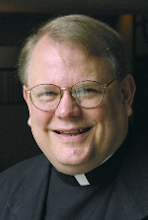
Monsignor James P. Moroney
Rector


Destruction and violence are before me; there is strife, and clamorous discord," Habbakuk laments. 'But you, O Lord, do nothing to stop it...why must I gaze at this misery!?'
How often we make the lament of Habakuk our own! Violence and misery, wars and murders, suicides and betrayals, people stripped of their dignity and even their humanity...Its never been so bad, and it's as if God doesn't care!
Well it has been this bad, and it probably will be until the day we depart this valley of tears, but the reason for the violence, dear Habakuk is not the will of God, but the deeds of men, for as Pogo used to say, I have met the enemy, and he is us!
Whether we're Cain, the King or the Pharaoh, it is our sin which is the author of violence and our hardened hearts which incubate our own misery.
Cain
The primordial act of violence in the scriptures is raised in the heart of Cain. The scriptures tell us that Cain raised wheat, while his younger brother Abel raised sheep, one a cattleman, the other a farmer. And when they went to offer sacrifice to God, Abel's offering was seen as more pleasing. At which Cain grew jealous and killed his brother in a jealous rage!
Jealousy was and is is the green-eyed monster, ever longing for the greener grasses in the other fellow's yard. Jealousy is never satisfied and almost always leads to a violent rejection of the will of God. Uh, excuse me God, I think you must have made a mistake. This is the life you chose for me? But where's the yacht, or the private plane, or the awards for my stunning beauty, or the perfect children, or the Nobel prize, or the bit about being smarter or more powerful than everybody else? Where indeed, is al that stuff I know will make me happy? Well if you won't give it, I guess Ill just have to take it!
And so we make believe we know best, or at least better than God what's best for us, and so we plot and plan our destinies. And despite the fact that our schemes must be very amusing to God, we plug right on, for ours is the kingdom and the power and the glory...by hook or by crook. Jealousy is a miserable little wretch.
The King
And then there's the King, and his murderous lust for Bathsheba, which leads the great David to the deceitful slaughter of her husband Uriah. There were really two murders committed by King David that day...one of the virtue of Bathsheba, whom David turned from a person to a thing, and then the brutal killing of one of his most loyal soldiers. All out of a desire to possess the one who did not belong to him and his childish willingness to treat human persons like toy soldiers for the fulfillment of his own fantasies.
It's the same violence we embrace each time we seek to defraud another of their human dignity, to dehumanize the one God made in his image and likeness, ignoring who he made them to be.
It's the sin that drove a young freshman to the George Washington bridge this past week....it's the sin of every kind of pornography...whether the Internet kind that turns vulnerable young people into things we use for our selfish amusement or the political kind that turns all public servants and personalities into objects of ridicule and derision.
Such sins refuse to accord respect to anyone. Everyone is subject to our use and abuse, twisted and destroyed for our entertainment. Policemen or parents, jurists or presidents, priests or physicians, each are but another titillating opportunity to turn real people into jokes, to deride embarrass, and destroy...oh, how the mighty have fallen! So we revel in their misery! What fun for the giggling crowd!...the worst kind of character assassination, worthy neither of the fifth grade school yard, of twitter, TV or the blog. For if I have not love, I am nothing. And if I have not respect, I cannot love.
The Pharoah
And then there;s the genocide of Pharaoh. It started with the death of Joseph and his brothers, the last of the sons of Jacob. Exodus tells us why the genocide begins: “the Israelites were fruitful and prolific. They became so numerous and strong that the land was filled with them.” (Exodus 1:7).
It’s the fear of the stranger, then, that moves Pharaoh to enslave the people whom he knew not! So he does two things: First, he makes all the Israelites slaves, appointing cruel taskmasters over them. And then he calls in the Jewish midwives and commands them to kill every newborn Hebrew child.
Such hatred is as timeless as fear itself: fear of the unknown, fear of the stranger that grows into a desire to make those people just disappear. And while the fear has been the same in every human heart, the identity of those people changes with each generation in every land. For the Hutus, those people are the Tutsis, for the Nazis, they are the Jews....for the Jews they are the Palestinians....and even here in Worcester, for the Yankees they were the Irish, for the Irish they were the French, for the French, they were the Italians, for the Italians they were the Puerto Ricans, for the Puerto Ricans, they were the columbians, and on and on and on, in never ending cycles of suspicion of the next one down on the ladder, breading hate, discrimination, and even violence.
The antidote to such fear, of course, is the confidence of the children of God, who welcome the alien as a brother, treat the stranger as they treat their Lord, and even seek to love their enemies as they love themselves.
So what's the remedy? Is it our good reason, our common sense, or our ability to figure it all out. Hardly! For left to our own devices, we only succeed in digging ourselves deeper and thickening the web of our sins and deceptions.
Our only hope is to be redeemed by Christ, with absolute faith in him, and an absolute surrender to his will, that the hardening of our hearts might be redeemed by the blood which flows from his side. For at the end of the day, 'We are nothing but unprofitable servants, who if they had faith but the size of a mustard seed, would never know violence or misery, ever again.
Monsignor James P. Moroney
Rector

"...the Christian message has been an integral part of the language, thought and culture of the peoples of these islands for more than a thousand years." -Pope Benedict XVI at Holyroodhouse on Thursday

Homily
Twenty-fifth Sunday in Ordinary Time
Tomorrow morning in Crofton Park, not far from the airport in Birmingham, England, Pope Benedict XVI will beatify John Henry Cardinal Newman in the presence of 100,000 people, including Monsignor Sullivan. And in his homily, the Pope will recall Newman’s heroic accomplishments as a “champion of English spirituality,” a ‘synthesizer of faith and reason,’ and one of the finest theologians ever born on the British isles.
We’ll hear of how Leo XIII named him a Cardinal, how15,000 people stood in the rain at his Funeral, and how even the secular press hailed him as “a man of singular purity and beauty of character...”
Quite a man, and quite a saint.
Almost makes you wonder, though: if it took over a hundred years to beatify someone like that, what chance do we have?
What chance indeed? Especially if what made him holy were those mighty deeds and vast accomplishments! But the truth is, that holiness comes neither from mighty deeds, nor from vast accomplishments, but from the infinite number of little moments of sacrifice and love which conform us to Christ, bit by bit. It’s like the Lord tells his disciples in the Gospel today: Who’s the one whom God can trust in great thing? “The person who is trustworthy in very small matters...”
Saints get to heaven when, as Mary declared, God looks upon them in their littleness, and accepts the thousand little ways, the seemingly insignificant sacrifices of a person’s life.
Listen to what one nun once wrote in her journal:
“There's one sister in the community who has the knack of rubbing me the wrong way at every turn; her...manner, her...speech, her character, [all] just strike me as unlovable. But, then...God must love her dearly; so I wasn't going to let this natural antipathy get the better of me. So I determined to treat this sister as if she were the person I loved best in the world. Every time I met her, I used to pray for her, offering to God all her virtues and her merits...But I didn't confine myself to saying a lot of prayers for her, this sister who made life such a tug-of-war for me; I tried to do her every good turn I possibly could. When I felt tempted to take her down with an unkind retort, I would put on my best smile instead, and try to change the subject. Once at recreation she actually said, beaming, ..."...Sister, what it is about me...? You've always got a smile for me whenever I see you."...I could only say that the sight of her always made me smile with pleasure--naturally I didn't explain that the pleasure was entirely spiritual.”
That’s how Sister Theresa of the Child Jesus became Saint Theresa of Lisieux.... by choosing to love the most unlovable person in her house through a thousand daily sacrifices...and doing it so convincingly that until her death everyone around her, including her two sisters, were convinced that this nun (the one who really drove her so crazy all the time) had been her dearest friend!
And it’s the same with us. We do not find real holiness in the great, the dramatic and the spectacular, but in the every day moments of life.
For “This is how we go on:,” a modern writer reminds us, “one day at a time, one meal at a time, one pain at a time, one breath at a time. Dentists go on one root canal at a time; boat builders go on one hull at a time. If you write books, you go on one page at a time...and turn our attention to the next meal, the next pain, the next breath, the next page. This is how we go on.”
And this, is how we get holy.
After thirty years of being a priest, I am absolutely clear on what moment I witnessed the greatest act of holiness. It was in the hospital in Leominster, late one night.
Helen and John has been married for over fifty years and Helen was at the end of a long and painful struggle with cancer. While she was conscious, she was barely able to whisper and it was clear that she was very much near the end. I said the litany and the prayers for the commendation of the dying amidst many tears and hugs and gestures of good bye, all the while with my right hand in Helen’s and my left arm around old John...until Helen, at one point, pulled her hand from mine and gestured for me to come closer.
“Father,” she softly whispered, “ I need you to do me a favor.” “Anything,” I told her. “Anything you want, Helen...” “When I die,” she whispered weakly in my ear, I want you to go to our house...and in the bedroom closet, up on the shelf there’s a white box. Open the box. And inside you will fine a new white shirt. Make sure John wears it to the funeral, because I don’t want them saying I didn’t make sure he had a clean white shirt.”
She smiled weakly as I stood up and they all looked at me, anxious to hear her dying wish. I just smiled back, and watched as John held Helen and Helen held John with an affection they had shown in a billion little ways for ten thousand days...And only at the funeral, did I reveal her secret request, and after they all stopped laughing, including John in the clean white shirt, there was silence, as they all realized that Helen and John had taught us all the way to holiness...through the little things....the “ordinary contact with God..the daily encounter with Christ...
[A life]...lived without fuss, with simplicity, with truthfulness.
So you wanna be holy, you wanna be a like Blessed John, or Saint Theresa, or even Helen?
There’s only one way: "be faithful, very faithful, in all the little things."
Monsignor James P. Moroney
Rector

Homily
Twenty-Fourth Sunday in Ordinary Time
The Pharisees accuse Jesus of hanging around with sinners and eating with them, and he responds with three questions: Did you ever meet a sheepless shepherd, a coinless housekeeper, or a sonless father?
No father I know, no housekeeper I know, no shepherd I know would ever act like that. For Jesus is not talking about earthly shepherd, housekeepers and father.
This shepherd is the good shepherd. And this housekeeper is the God who never gives up on us. And this father is the one who waits for us in all our prodigality.
The good shepherd knows his sheep and they know him. He lays down his life for them and protects them from the wolf. But today we hear what happens when just one wanders away. Just one. For just one sheep he leaves the flock and goes in search, so much does he love the stray.
I've had a favorite print of this scene hanging in my room since I was first ordained. Just over the edge of a cliff, a lost lamb is entangled in the brambles, having lost it's footing. As a vulture circles overhead the lamb is literally petrified, its joints locked with fear. While with one hand precariously grasping a tree branch, the good shepherd reaches over the cliff to save the lamb, whom he will soon carry home on his shoulders, to the safety of the other ninety nine.
The lost sheep is the young person who, flush with the newfound freedom of early adulthood, wanders away from the Church in search of pleasure and soon falls off the cliff of his own desires, entangled in the selfishness of opportunism, while the vultures of greed circle around his head. But don't worry. For the Good Shepherd is out there seeking him along with his Blessed Mother and every angel and saint. Pray to them for him. For when things look the most precarious, when life appears to have finally fallen hopelessly apart, the goos shepherd will be there to grasp his hand, to pick him up, and to carry him home.
We can never stray so far that God cannot find us. And the Good Shepherd never gives up on the lost sheep.
As the Good Housekeeper values each one of her coins, even when she loses just one penny in the middle of the night. It doesn't matter that its just a penny. She still gets up out of bed, lights the lights, and sweeps every possible corner until she finds it.
She loves even the littlest penny the way that God loves the lowliest sinner. The penny is the addict, who has robbed, cheated and stolen his way through life. His wife gave up on him. The kids, from all three women, gave up on him. Even his mother and father and brothers gave up on him. And he sits in a cell, bloated with emptiness and bitter regret. He is the least of men, and no one will even notice when he dies.
No one but the God who made him, and who has been searching for him through the darkness of each night of his life, sweeping the alleys, looking among the broken dreams that define his horizons. He seeks him
And when this lost penny is found, there will be more rejoicing in heaven than over a whole Cathedral full of righteous ones. And he will call in the angels and saints to celebrate...for this lost little penny of mine is found....let the celebration begin.
As the Father of the prodigal Son, your father and mine, gives us everything....more than our share of the estate...he gives us the cool Fall breezes, the giggling and smile of a little child, the blueness of the sky and the beauty of the flowers, the sound of the voice of the person who loves you, and the whole world, for as far as you can see. It’s all for you.
And what do we do with this grand inheritance? We abuse his creation for our entertainment, we use people for our pleasure, and head off for distant countries, far from his love, where we squander our inheritance on a life of dissipation.
And when we have spent everything....our purity, our innocence, and even our love...when we have sold it all to the highest bidder, we come running back to him, seeking to strike one more bargain....seeking to treat him like just one more merchant to be bought and sold.
And what does he do? Does he scream at us, “You did what?” Do the corners of his mouth inflict a scowl of disappointment and remind us of our sin? Does he turn his back on us in justice and deserved derision?
No, he runs out to meet us, throws his arms around us, interrupts our silly bargaining, and throws a banquet in our honor, never ending, in his Heavenly Kingdom. All because we were sorry, and all because we came home.
And when we complain about how merciful he is being to our brothers when we’ve been working our hands off and he doesn't care when when we whine that he should have thrown the little runt out on his head. When we return bitterness for love and ambition for kindness.
He patiently reminds us of his love, and how he’s made all this for us, of how we will be with him forever, of how we have to celebrate and rejoice, for the one who was dead has come back to life and the one who was lost is found.
That’s what he does, this friend of sinners, this seeker of the lost, this lover of the prodigal, who has mercy on Pharisees and on us.
Monsignor James P. Moroney
Rector

Twenty-third Sunday in Ordinary Time
Homily
Onesimus was a slave, sent by Philemon to take care of Saint Paul in prison. Now the idea of sending a servant to someone in prison makes little sense in our own day, but in Paul's prison, the residents were expected to provide for their own needs, and the elderly Paul was not quite up to the task. Remember, by this point in this life he had been imprisoned several times, arrested on four occasions, and once stoned and left for dead.
So Philemon sends his slave Onesimus to the old Paul in order to help him to get by. But, it appears from Saint Paul's words, that Onesimus did not remain a slave for long. Indeed, he becomes a dear friend to the old Apostle, one whom he refers to as "of my own heart."
And then, in a curious turn of phrase, Saint Paul suggests that Onesimus is something even more than a friend...he is, in Pauls own words, a man and a brother.
From slave to beloved to brother. What does this all mean?
From Slaves to Friends
In the beginning, we are all duloi,or slaves. Slaves to our passions, slaves to our needs, slave to selfishness and sin. And then, starting with those fights with our younger sisters and older brothers and by the competitions of the schoolyard, we turn from slaves to free men and women, liberated from our narcissism, we become beloved friends.
Do you remember your first friends? I do. We'd ride bikes together and take the bus to Worcester on Saturdays to buy Superman comic books at the old Bus station (see how old I am?) and visit the old Science Museum behind the chancery, the library and the Cathedral. It's almost fifty years ago, but I can still remember the joy and the trials of first being called a friend.
And since then, each friendship has been more of the same. Best friends, spouses, colleagues and acquaintances. Each beloved not for what they can do for you, but for who they are. In the image of Christ Jesus, who commands us to love one another as he has loved us, we learn the meaning of passion and sacrifice, of self-emptying and letting go, of dying and rising in loving those whom we call beloved in our lives.
Such love is never easy, but it is the treasure beyond all price, for in true love we see a true reflection of the face of Christ upon the cross. Such love, Saint Paul tells us, is patient, kind, does not put on airs...and most of all, is merciful.
Perhaps mercy is the acid test of love, for it is given at the moment when we have precisely nothing to gain and all to give. Father forgive them, Christ prays from the altar of the cross, for they know not what they do.
I remember one day several years ago flying out of Washington DC with an old friend of mine. It was a cross country flight and one for which we had planned for many months. Upon leaving the house he went to drive to BWI, the airport about a half hour up the Baltimore Washington Parkway. What are you doing, I practically shrieked...we're flying out of DCA, a half hour in the other direction. I don't think so, James, he calmly came back. Im sure the itinerary said BWI. Well you're just not as used to traveling as I am, Im sure it was DCA. And when he suggested we get out and look at the packed itinerary, I stubbornly insisted: Trust me, it's DCA.
Well, as we left DCA a half hour later, having discovered he was right all along, with the fear that we would now miss our flight due to my insufferable self-assuredness, I was very quiet, until I sheepishly looked up at him, expecting, at the very least, to be berated for my mistake.
But to my surprise, he smiled, laughed softly, and mercifully reminded me, we can
always get get the next flight. I make mistakes like that all the time.
Love is patient. Love is kind. And most of all, it is merciful.
Brothers
But the story of Onesimus brings us one step further in relationship. Further than a best friend, further than a spouse. For Onesimus goes from slave to beloved to brother.
Brothers or adelphoi in Greek, is one of Saint Pauls favorite words, but he uses it advisedly. Adelphoi is a non-gendered word in Greek...it means brothers and sisters alike...like the Italian fratelli or the Spanish hermanos.
We become brothers and sisters by virtue of our relationship to Jesus, who no longer calls us slaves, but friends, brothers and sisters. And because we have become his adelphoi, we have become adopted sons of his Father in heaven. And that's the whole point! We are Gods children, the siblings of the Son of God and the children of God.
That changes everything. Because if God is our Father, we can pray to him, trust in his mercy and are heirs to his heavenly kingdom.
It changes everything, because if God is our Father and Jesus is our brother, we can learn from the first born Son how to live and to love, trust that when we get lost, he will go out to look for us and will carry us home and rest assured that our judge on the last day is also our intercessor, the one who desires not the death of his brother, but that he repent and live!
This is why Saint Paul so often begins his letters to the various churches he has founded with the vocative Adelphoi: Brothers and sisters, Church, sons and daughter of the one Father. For this is our essential identity, and the very reason for our being. Why did God make me? To be a brother to you in Christ: a part if this holy people, this royal priesthood, no longer a stranger in a strange land, but your brother, joined to you in an intimate union of sacrificial life and love.
For, we do not get to heaven alone, Saint Paul and Onesimus teach us, but as God's holy people, joined in a bond of sacrificial love as his Church...no longer a slaves...but more than a slave, as brothers and sisters in the Lord.
Monsignor James P. Moroney
Rector